Chapter 54: The Infinite Game: Chess as a Lifelong Companion
The Final Chapter of The Grandmaster Codex
"Chess is life in miniature. Chess is a struggle, chess is battles." : Garry Kasparov
What You'll Learn
- Why chess is more than a game. it is a way of thinking
- How the skills you built across these five volumes extend far beyond the board
- The neurodivergent brain as a gift, not a limitation
- What it means to pass the knowledge forward
- Why the game never ends
You Are Here 🗺️
Volume V ██████████████████████████████
Ch 46 ██ ✓
Ch 47 ██ ✓
Ch 48 ██ ✓
Ch 49 ██ ✓
Ch 50 ██ ✓
Ch 51 ██ ✓
Ch 52 ██ ✓
Ch 53 ██ ✓
Ch 54 ██ ← YOU ARE HERE. THE SUMMIT
There are no exercises in this chapter. There is no quiz. There is no progress check.
This chapter is a conversation between two people who love chess. you, and the voice that has been sitting across the board from you since page one.
Set aside the clock. Put away the notation sheet. This one is just for us.
PART 1: THE MOUNTAIN
The View from the Top
You have done something extraordinary.
Fifty-three chapters ago, you learned how the pieces move. You set up your board for the first time. or perhaps the thousandth time, but with new eyes. You studied the rules. You practiced basic checkmates until your hands remembered the patterns before your mind could name them.
Then you kept going.
You learned the 30 tactical patterns. You studied Morphy's Opera Game and felt, maybe for the first time, what it means to play with clarity and purpose. You built your first opening repertoire. You lost your first tournament games and felt the sting. You analyzed those losses honestly, the way Botvinnik taught, and you found the mistakes, and you grew.
You learned prophylaxis. You studied pawn structures until you could feel a weak square the way a musician hears a wrong note. You trained your calculation until you could hold positions in your mind's eye. not just the pieces, but the tensions between them, the plans hiding in the geometry of the board.
You studied Karpov's squeeze and Tal's fire. Petrosian's fortress walls and Fischer's clarity. Carlsen's relentless grinding and Polgar's fearless brilliance. You saw Gukesh become the youngest champion in history and learned that the future of chess belongs to minds that refuse to accept limits.
You trained your body alongside your mind. You learned that sleep matters, that nutrition matters, that physical fitness is not a luxury for chess players but a foundation. You addressed anxiety, not by pretending it does not exist, but by building strategies to live alongside it.
You solved three thousand exercises. Many of them defeated you on the first attempt. Some defeated you on the fifth. But you came back. You always came back.
And now you stand at the summit.
The air is thin up here. The view is vast. You can see the entire path you have walked. every lesson, every loss, every small breakthrough that felt enormous in the moment.
Take a breath. You have earned this.
What the Numbers Say
If you have worked through these five volumes with honest effort. not memorizing, but understanding. your chess strength is in the range of 2400 or higher. That places you in the top fraction of one percent of all chess players who have ever lived. Depending on where you live, you may be the strongest player in your city, your region, perhaps your country.
The numbers matter. They are a measure of real growth, real skill, real understanding. Be proud of them.
But the numbers are not the point.
PART 2: CHESS: THE HUMAN BRAIN'S PROGRAMMING LANGUAGE
What Chess Actually Teaches
Chess is not just a game. It is a language. perhaps the most precise language the human brain has ever encountered for reasoning about decisions under uncertainty.
Consider what you have learned to do:
You have learned to evaluate. Every position on the chessboard presents a cluster of competing factors: material, space, time, structure, safety, activity. You have trained yourself to weigh these factors simultaneously and arrive at a judgment. This skill: the ability to evaluate a complex situation with incomplete information: transfers directly to every important decision you will ever make. Career choices, financial decisions, relationship conflicts, health decisions: all of them involve weighing competing factors and making the best choice you can with what you know.
You have learned to calculate. You can project a sequence of events forward in time, hold the intermediate states in your mind, and evaluate the outcome. This is precisely what mathematicians do, what programmers do, what engineers do, what strategists do. The chess board was your training ground, but the skill belongs to you now. It works everywhere.
You have learned to plan. You can look at a position and see not just what is: but what could be. You can construct a sequence of moves aimed at a long-term goal while adapting to immediate challenges. Planning is the highest cognitive function, and you have practiced it for thousands of hours.
You have learned to lose. This may be the most important lesson of all. You have sat across the board from someone, given your best effort, and failed. You have felt the frustration, the self-doubt, the urge to quit. And you did not quit. You analyzed the loss, extracted the lesson, and came back stronger. This capacity: to transform failure into fuel: is the single greatest predictor of success in any field.
You have learned to decide under pressure. Clock ticking, opponent staring, rating points on the line: and you made a move. You committed. You took responsibility for the outcome. This is courage, even if it does not look like the kind of courage that makes headlines. It is the everyday courage of choosing action over paralysis, and it will serve you for the rest of your life.
The Cognitive Legacy
Neuroscience research consistently demonstrates that chess training produces measurable cognitive benefits:
- Pattern recognition. Chess players score higher on visual pattern recognition tests, and this advantage extends to non-chess domains.
- Working memory. Holding complex positions in your mind strengthens your working memory capacity, which is the cognitive foundation for reading comprehension, mathematical reasoning, and problem-solving.
- Executive function. The discipline of chess training. setting goals, managing time, evaluating progress, adapting strategies. directly exercises executive function, the set of mental skills that allow you to plan and execute complex tasks.
- Emotional regulation. Competitive chess forces you to manage frustration, anxiety, and overconfidence in real time. This emotional training produces measurable improvements in emotional regulation outside of chess.
These benefits do not fade when you close the book or walk away from the board. They are part of you now. They are wired into your neural pathways, built through thousands of hours of deliberate practice.
You have programmed your brain with one of the most elegant systems humanity has ever devised.
PART 3: THE NEURODIVERGENT GIFT
Your Different Brain Was Never a Disability
This section is personal. Not every reader of the Codex is neurodivergent. But this book was designed by a neurodivergent mind, and it was designed for neurodivergent minds. among others.
If you are autistic, if you have ADHD, if you have dyslexia or dyscalculia or any other neurological difference. listen carefully:
Your brain was built for chess.
The pattern recognition that makes you see connections others miss? That is the same ability that lets a Grandmaster look at a position and know. without calculating. that the knight belongs on e5. The hyperfocus that makes you lose track of time when something captures your interest? That is the same intensity that allows a player to analyze a single position for six hours without noticing the world outside the board. The need for systems, for structure, for things that make sense? That is the same drive that built the analytical frameworks of Nimzowitsch, Botvinnik, and Dvoretsky.
Bobby Fischer almost certainly had traits consistent with autism spectrum conditions. His pattern recognition was otherworldly. His need for systems and control was absolute. His social navigation was profoundly difficult. He was, by any measure, one of the greatest chess minds in human history.
Paul Morphy, whose games lit your path in Volume I, showed clear signs of what we would now recognize as neurodivergent traits. His ability to see the board with startling clarity, his obsessive dedication to chess followed by his complete withdrawal. these are patterns familiar to many neurodivergent people.
Magnus Carlsen has spoken about his unusual memory and processing style. Hikaru Nakamura plays with a speed and pattern recognition that suggests extraordinary neural wiring. Judit Polgar's father explicitly studied how differently-structured learning could produce elite performance. and the Polgar sisters proved that unconventional approaches to education can produce results that the traditional system never imagined.
Your different brain is not something you succeed despite. It is something you succeed because of.
The chess world has not always understood this. Tournament halls can be sensory nightmares. Social expectations around post-game analysis can be overwhelming. The assumption that everyone processes information the same way. in lessons, in books, in commentary. has excluded many brilliant minds from reaching their potential.
This book was built differently. Every chapter follows the same structure because predictability reduces cognitive load. Every exercise includes hints because no one should be left without support. Every section has rest markers because your brain deserves permission to pause. The reading level stays accessible because clarity is not a sign of simplicity. it is a sign of respect for the reader.
If this approach worked for you. if you found yourself learning more easily, more deeply, or more joyfully from these pages than from other chess books. that is not an accident. It is the result of deliberate design, informed by lived experience of what it means to think differently.
And if you ever doubt whether your brain is "right" for chess. remember the Opera Game. Remember Fischer's queen sacrifice at age 13. Remember Polgar defeating Kasparov.
Your brain is not broken. It is specialized.
PART 4: THE STORY BEHIND THIS BOOK
How the Codex Came to Be
Every chess book has a story. This one's story begins with a girl who learned chess in a single day and beat veterans at her first tournament.
The author of this book was not a child prodigy. She was not trained by Soviet coaches. She did not grow up in a chess family. She was a neurodivergent kid who discovered chess and found, for the first time, a place where her brain's unusual wiring was an advantage instead of a burden.
She learned the rules in one sitting. She played her first tournament game within weeks. And she won. against players who had been studying for years.
That experience. the feeling of a mind finding its native language. is what this book is built on.
The Grandmaster Codex was not written to show off. It was not written to prove a point. It was written because the author looked at the chess education world and saw what was missing: a thorough, accessible, neurodivergent-friendly curriculum that could take a complete beginner to Grandmaster-level understanding without requiring a private coach, a wealthy family, or a neurotypical brain.
Three thousand exercises. Two hundred annotated games. Five volumes spanning the full spectrum of chess skill. Designed from the ground up for brains that think in patterns, that need structure, that learn best when the path is clear and the destination is visible.
This book is the coach she wishes she had.
If it worked for you. if it taught you something real, if it helped you grow. then it has fulfilled its purpose.
PART 5: PASSING THE FIRE
The Obligation of Knowledge
You now possess something valuable. You have deep chess knowledge. the kind that took years of study and thousands of exercises to build. You understand openings, tactics, strategy, endgames, psychology, and preparation at a level that few people in the world achieve.
This knowledge does not belong to you alone.
Chess has survived for fifteen centuries because every generation has taught the next. Morphy learned from Philidor's writings. Steinitz built on Morphy's ideas. Nimzowitsch extended Steinitz. Botvinnik systematized Nimzowitsch. Fischer learned from all of them. And every one of them, in turn, left their knowledge behind for those who came after.
You are part of this chain now.
There is a kid at a chess club somewhere. maybe in your city, maybe on the other side of the world. who is about to discover the same magic you found in these pages. They are going to sit down at a board, move a pawn forward, and feel the first spark of a lifelong fire.
That kid needs a teacher. Maybe that teacher is you.
How to Teach
You do not need a title to teach chess. You do not need a certification. You need three things:
- Knowledge. which you have.
- Patience. which chess has taught you.
- The memory of what it felt like to not understand. which is the most important teaching tool of all.
When you teach, remember what these pages taught you:
- Lead with the why, not the what. "The knight goes to e5 because it controls the center and cannot be chased by a pawn" is teaching. "Put the knight on e5" is ordering.
- Give permission to fail. "If you got this wrong, good. it means you're pushing your limits."
- Respect different learning speeds. Some students need ten repetitions. Some need a hundred. Both are normal.
- Make the structure clear. Your student should always know where they are and where they are going.
- Celebrate progress. A student who can deliver checkmate with king and rook has accomplished something real. Tell them so.
If your student is neurodivergent. and statistically, some of them will be. remember what worked for you. Structure. Predictability. Clear expectations. Permission to stim, to fidget, to take breaks. Exercises that start easy and build. Validation that their brain is an asset, not a problem.
You have the power to change a life with a chessboard and an hour of your time. Use it.
Starting a Legacy
Chapter 52 asked what you would contribute to chess. Here are some paths, worth repeating because they matter:
Write. Annotate your best games. Publish analysis. Create studies on Lichess. Write articles for your club newsletter. Document what you have learned. Words on a page outlast any tournament result.
Teach. Volunteer at a school chess club. Offer free lessons to beginners. Mentor a younger player. The chess community grows one teacher at a time.
Organize. Start a tournament. Build a chess club. Create a community. The strongest chess cultures in the world: Russia, India, the United States: were built by people who organized, not just played.
Create. Build chess tools. Develop training software. Design puzzles. Record video lessons. Write a book of your own someday.
Play. Never stop playing. Your continued presence at the board: your games, your analysis, your competitive fire: contributes to the living tradition of chess. Every game you play adds to the collective knowledge of humanity's oldest intellectual pursuit.
PART 6: THE INFINITE GAME
Finite Games and Infinite Games
A philosopher named James Carse once described two types of games:
Finite games are played to win. They have fixed rules, clear boundaries, and definitive endings. A chess tournament is a finite game. It starts on Monday, ends on Sunday, and someone takes home the trophy.
Infinite games are played to continue playing. They have evolving rules, shifting boundaries, and no final ending. The purpose is not to win: it is to keep the game going.
Chess, in its deepest sense, is an infinite game.
The tournament ends. The rating stabilizes. The title is earned or not earned. But the game. the study, the wonder, the conversation between two minds across 64 squares. never ends.
You will play chess when you are forty. You will play when you are sixty. You will play when your hands shake and your eyes need stronger glasses and the young players across the board cannot believe that someone your age can still find a combination in the time it takes them to consider their candidates.
You will play because chess gives you something that nothing else in the world provides: a space where your mind can be fully itself.
Not performing for others. Not meeting expectations. Not navigating social norms or sensory overload or executive function demands. Just you, the board, and the infinite depth of a game that humanity has been exploring for fifteen hundred years and still has not exhausted.
What Chess Gave You
Let us be honest about what chess has given you across these five volumes:
Discipline. You did not get here by accident. You showed up. You did the work. Day after day, exercise after exercise, loss after loss. That discipline is yours forever.
Resilience. You have been knocked down by a position that defeated you, a tournament that humbled you, a chapter that frustrated you. And you got back up. Every time.
Community. Chess connects you to millions of people across every continent, every culture, every language. When you sit down at a board with a stranger, you share a vocabulary that requires no translation.
Beauty. You have seen things that are genuinely beautiful: combinations that unfold with the precision of mathematics and the grace of poetry. Morphy's queen sacrifice. Fischer's knight maneuver. Kasparov's king hunt through half the chessboard. These are works of art, and your ability to appreciate them: to feel their beauty: is a form of literacy that enriches your life.
Identity. You are a chess player. Not a casual dabbler, not a hobbyist, not someone who "used to play." You are a chess player in the deepest sense: someone who understands the game at a level that most people never reach, who carries its patterns and principles in the architecture of their thinking.
That identity does not depend on your rating. It does not depend on your title or your trophies or whether you play in tournaments next year or ever again. It is woven into who you are.
What You Gave Chess
And let us be honest about what you have given chess:
You gave it your time. Hours, weeks, months, years of your finite life spent studying, practicing, competing, growing. Time is the only truly irreplaceable resource, and you invested it in mastering something beautiful.
You gave it your attention. In a world that fractures concentration into ever-smaller fragments, you sat down and focused. deeply, intensely, for sustained periods. on a single position, a single game, a single idea. That attention is increasingly rare, and it matters.
You gave it your struggle. Every game you lost, every exercise that defeated you, every moment of frustration and doubt. those were contributions. They were the raw material of growth, and through them, you joined the community of everyone who has ever struggled to understand this game and kept trying anyway.
You gave it your love. If you made it to Chapter 54 of a five-volume chess curriculum, you love this game. That love sustains chess. It is what keeps the game alive. not corporate sponsorship, not streaming numbers, not engine evaluations. Love.
PART 7: THE LAST POSITION
A Final Thought
Here is the last position you will study in The Grandmaster Codex.
Set up your board:
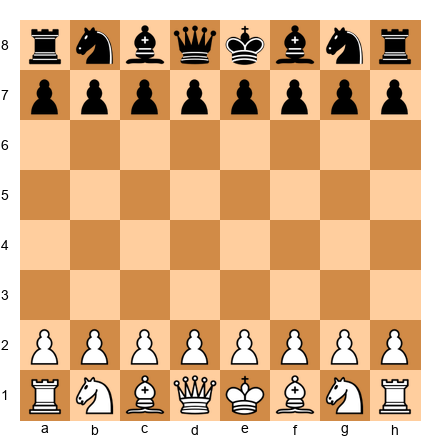
The starting position. Every piece on its home square. No moves played. No advantages earned. No mistakes made.
This is where it all began. for you, for Morphy, for Fischer, for Kasparov, for every child who ever looked at a chessboard and felt the pull of possibility.
And this is where it begins again. Every time you set up the pieces. Every time you press the clock. Every time you look across the board at your opponent and wonder what they are thinking, what they have prepared, what they will do. and what you will do in return.
The position is equal. The possibilities are infinite. The game is yours.
"Every chess master was once a beginner." : Irving Chernev
A Note from the Author
If you have read all five volumes. if you have solved the exercises, studied the games, built your repertoire, and arrived at this final page. then you have my deepest respect and my genuine gratitude.
You trusted this book with your chess education. You spent hundreds of hours with these pages, working through positions that challenged you, concepts that stretched you, and exercises that sometimes defeated you. You kept going.
I wrote this book because I believe that every mind deserves access to the best chess education possible. regardless of income, geography, neurotype, or background. I wrote it because the chess books that existed when I was learning did not work for my brain, and I knew they did not work for many other brains, and I believed something better was possible.
Whether this book made you a Grandmaster or simply a better chess player. whether it earned you a title or simply earned you the ability to see the board more clearly. it has done its job.
Go play. Go teach. Go contribute. Go live.
And when you sit down at the board tomorrow, know this:
You are carrying fifteen hundred years of human thought in your mind. Every game you play adds to that tradition. Every student you teach extends the chain. Every position you analyze deepens our collective understanding of this inexhaustible game.
The board is set. The clock is running.
Your move.
The Grandmaster Codex. Volumes I through V 3,000+ exercises. 200 annotated games. 54 chapters. From first move to final mastery.
For every brain. For every player. For all time.
But we are not quite finished, you and I. There are things left to say.
Things about your brain. About teaching. About the games that lie ahead. And about how this all ends, which is to say: how it does not.
PART 8: THE NEURODIVERGENT MIND IN FULL
A Deeper Truth
Part 3 of this chapter introduced an idea that deserves more space, more honesty, and more specificity. If you are neurodivergent, what follows is for you. If you are not, what follows will help you understand the people in your chess community who are.
And if you are not sure whether you are neurodivergent: that uncertainty itself is worth sitting with. Many people discover their neurodivergence through chess. The game has a way of revealing how your mind actually works, stripped of the masks and accommodations you have built for the rest of the world.
Chess as the Perfect Neurodivergent Sport
Think about what chess asks of you.
It asks you to sit in one place and focus intensely on a single problem for hours at a time. It asks you to recognize visual patterns at high speed. It asks you to build and maintain complex internal systems. It asks you to memorize long sequences of moves and recall them under pressure. It asks you to think in structures, in rules, in logical chains where one idea follows inevitably from the last.
Now think about what chess does not ask of you.
It does not ask you to read facial expressions in real time. It does not ask you to maintain a conversation while performing a separate cognitive task. It does not require you to process auditory information at speed, or to coordinate your body through space with athletic precision. It does not penalize you for stimming, for avoiding eye contact, for needing to pace between moves, for wearing headphones, for eating the same meal before every round, or for organizing your pieces on the table in a specific order before the game begins.
Chess strips away nearly everything that makes the neurotypical world difficult for neurodivergent people. What it leaves behind is pure cognition: pattern, logic, memory, and will. And in that space, the neurodivergent mind does not just compete. It excels.
This is not a feel-good statement. This is an observable fact, repeated across a hundred and fifty years of chess history.
The Evidence Is in the Games
José Raúl Capablanca learned chess at age four by watching his father play. He did not receive formal instruction. He simply observed the pieces, absorbed the rules, and began to play at a level that shocked adults around him. By age twelve, he was the champion of Cuba. By his twenties, he played chess with an effortlessness that mystified his rivals. He rarely studied openings. He seemed to see the correct move the way other people see the color of the sky: instantly, without effort, without needing to explain why.
Capablanca's contemporaries described his play as "natural" and "intuitive." What they were describing, in the language of their time, was extraordinary pattern recognition operating below the level of conscious analysis. His brain processed positions with a speed and accuracy that bypassed the deliberate calculation other masters relied on. He found social situations draining. He preferred the company of the board to the company of crowds. He could lose himself in a position for hours and emerge unable to account for the time.
These are not quirks. These are traits.
Bobby Fischer's story is even more stark. His single-minded obsession with chess consumed his life from childhood. He read chess books the way other children read adventure stories: hungrily, compulsively, cover to cover, over and over. He memorized thousands of games from the nineteenth century. He reorganized his entire understanding of opening theory from scratch, producing innovations that stunned the chess world.
Fischer also struggled with things that seemed easy for other people. He had difficulty maintaining relationships. He was rigid in his demands about playing conditions: lighting, noise, the size of the squares on the board, the brand of the pieces. He experienced the world with an intensity that could tip from brilliance to anguish in moments. His need for control, for predictability, for systems that made sense, was absolute.
The chess world of the 1960s and 1970s did not have the language to describe what was happening with Fischer. Today, we do. We recognize the pattern: an extraordinary mind wired for depth over breadth, for systems over social fluidity, for intense focus over easy flexibility. Fischer was not great despite his different wiring. His different wiring was the engine of his greatness.
Magnus Carlsen has spoken in interviews about his unusual memory. As a young player, he could recall not just the moves of specific games, but the page of the book where he read them, the position of the diagram on the page, the color of the binding. His ability to retain and retrieve chess information operates at a level that goes well beyond training. It reflects a brain that stores and accesses pattern information differently from the statistical norm.
Carlsen also plays with a stamina and focus that borders on the inhuman. He has won games in the seventh hour that other players would have drawn in the fourth, not because he calculates better when tired, but because his focus does not degrade the way most people's focus degrades. This sustained attention, maintained over brutally long sessions, is a trait that neurodivergent people often describe in the context of their special interests. When the task aligns with the brain's wiring, the usual limits of attention do not apply.
Hikaru Nakamura processes visual information at speeds that seem to defy human limits. In speed chess, he identifies patterns, calculates variations, and executes moves in fractions of a second, with an accuracy that suggests his brain is recognizing positions rather than analyzing them. This is consistent with the kind of rapid, automatic pattern matching that researchers have identified in autistic savants across many domains: music, mathematics, calendar calculation, visual art.
The Autistic Mind at the Board
If you are autistic, the chessboard may be one of the few places in the world where your brain operates without friction.
The board is predictable. It has exactly 64 squares, always in the same arrangement. The pieces follow fixed rules that never change. The logic is absolute: if a bishop is on a light square, it will always be on a light square. If a pawn reaches the eighth rank, it promotes. There are no social exceptions, no unspoken rules, no situations where the stated rules do not apply.
This predictability is not a limitation of chess. It is one of its deepest strengths. And for a mind that craves order, consistency, and logical structure, it is a relief. The chessboard does not require you to guess what it means. It says what it means. Always.
The autistic gift for pattern recognition maps directly onto chess skill. When researchers study how chess masters perceive positions, they find that masters do not see 32 individual pieces on 64 individual squares. They see chunks: clusters of pieces that form recognizable patterns. A fianchettoed bishop, a castled king position, a pawn chain, an outpost knight. These chunks are stored in long-term memory and retrieved automatically when a similar pattern appears on the board.
This is exactly how many autistic people process the world: in patterns, in systems, in templates that get matched against incoming information. The autistic chess player does not need to learn this skill from scratch. They bring it to the board already installed. What they need is exposure to positions: the raw material from which their pattern-matching engine builds its library. Given enough games, enough positions, enough study, the autistic mind builds a chess database of extraordinary depth and precision.
Deep analysis is another strength. The ability to sit with a single position for an extended period, turning it over, examining every variation, refusing to move on until the truth of the position has been found: this is how Botvinnik worked. This is how Karpov prepared. This is how the strongest engines operate today. And it is a natural mode for many autistic thinkers, who find shallow analysis unsatisfying and are drawn to complete understanding rather than approximate estimation.
If you are autistic and you play chess, you are not using a coping mechanism. You are using your native language.
The ADHD Mind at the Board
If you have ADHD, chess offers you something different but equally powerful.
The ADHD mind is often described in terms of deficits: attention deficit, impulse control deficit, executive function deficit. These descriptions are accurate in contexts that do not suit the ADHD brain. In contexts that do suit it, the ADHD mind has capacities that other brains struggle to match.
The first is creative pattern recognition. The ADHD brain does not filter information the same way a neurotypical brain does. It takes in more, discards less, and makes connections between ideas that seem unrelated. In chess, this looks like the player who finds a combination that nobody else considered, not because they calculated more deeply, but because they noticed something that others filtered out. A piece that could move to an unexpected square. A sacrifice that breaks the position open. A quiet move that changes the entire character of the game.
Mikhail Tal played chess this way. His combinations were wild, speculative, often unsound by strict analytical standards. But they worked because they came from a mind that saw possibilities where others saw walls. Tal did not play "correct" chess. He played his chess, and it was brilliant because his brain processed the board differently.
The second gift is what ADHD researchers call "interest-based attention." The ADHD brain does not have a true deficit of attention. It has a different system for allocating attention. When the task is uninteresting, attention scatters. When the task is interesting, attention locks in with an intensity that surpasses what most neurotypical brains can sustain. In chess, when the position catches fire, when the tactics begin, when the game enters the critical phase where a single move determines the outcome, the ADHD player is often more focused than their opponents, not less. The crisis sharpens them.
The third gift is speed. Many ADHD players excel at blitz and rapid chess because the time pressure forces their brain into a mode it handles well: rapid pattern recognition with minimal deliberation. The same player who struggles to maintain focus in a six-hour classical game may be untouchable in a three-minute blitz battle, processing positions at a speed that leaves methodical thinkers behind.
If you have ADHD and you love blitz but struggle with classical time controls, that is not a weakness. It is information about how your brain allocates its extraordinary resources. Work with that information, not against it. Structure your training to include rapid pattern recognition drills. Play time controls that engage your brain's strengths. And when you do play classical chess, build in physical movement between moves, keep water and snacks at the board, and forgive yourself for the games where your focus wanders. It will come back. It always does.
The Intersection
Many neurodivergent people carry more than one label. Autism and ADHD co-occur frequently. When they do, the chess player often displays a distinctive combination: the autistic depth of pattern analysis merged with the ADHD spark of creative combination. These players can study an endgame for three hours with the focus of a machine, then find a wild tactical shot in a blitz game that makes spectators gasp.
If this describes you, know that your combination of traits is not contradictory. It is complementary. The depth gives your creativity a foundation. The creativity gives your depth a spark. Together, they produce a chess mind that is uniquely equipped for the full spectrum of the game.
Your Brain Is Not Broken. It Is Built for This.
The world will tell you, in a thousand direct and indirect ways, that your brain is a problem to be solved. It will offer you treatments, accommodations, workarounds, and coping strategies, all aimed at making you function more like a neurotypical person in a neurotypical world.
Some of those supports are genuinely helpful. Take the ones that serve you.
But never let anyone convince you that the way you think is wrong. The brain that struggled in school may be the brain that finds a brilliant combination in a critical position. The brain that cannot maintain small talk may be the brain that maintains concentration through a seven-hour game. The brain that needs everything organized just so may be the brain that builds a preparation system worthy of a World Championship contender.
Capablanca's brain. Fischer's brain. Carlsen's brain. Your brain.
Not broken. Not deficient. Not disordered.
Built for depth. Built for patterns. Built for the infinite complexity of 64 squares and 32 pieces.
Built for chess.
PART 9: TEACHING OTHERS
The Duty of the Strong
There is an old idea in chess, one that predates formal coaching and structured curricula. It goes like this: if you are strong, you teach. Not because someone pays you to. Not because it advances your career. Because the game gave you something, and you owe it back.
Steinitz taught through his writings. Tarrasch taught through his tournament books. Nimzowitsch taught through My System, a book that shaped how an entire generation understood chess. Botvinnik taught Karpov, Kasparov, and Kramnik in his school, producing three World Champions from a single classroom. Each of these people was a great player. But their greatest contribution to chess was not the games they won. It was the knowledge they passed on.
You have studied fifty-four chapters. You have solved thousands of exercises. You understand chess at a level that places you among the strongest players in the world. That understanding is not meant to sit in your head, appreciated only by you. It is meant to flow outward, into the minds of the next generation.
Teaching is not charity. It is not sacrifice. It is the most natural extension of mastery: you learn, you internalize, and then you help someone else learn. The cycle has continued for fifteen centuries, and you are part of it now.
What Makes a Great Chess Teacher
You already know the answer to this question, because you have experienced great teaching across these five volumes. Great chess teaching has specific qualities, and they are worth naming.
A great teacher meets the student where they are. Not where the teacher wishes they were. Not where the curriculum says they should be. Where they actually are, right now, with the knowledge and skills and fears and misconceptions they carry to the board today. If your student thinks the queen is the most important piece, you do not scold them. You show them a game where a rook endgame decided everything. You let the board teach.
A great teacher explains the why. "Put your rook on the open file" is an instruction. "Put your rook on the open file because it will control the only path into your opponent's position, and that control gives you the initiative" is a lesson. The difference between instruction and teaching is the word "because." Use it often.
A great teacher normalizes failure. Your student will hang pieces. They will miss forks. They will play the opening you taught them and then forget the key idea on move six. This is not a problem. This is learning. Every mistake is evidence that your student is trying something difficult, and trying is the only path to growth. When your student blunders, do not sigh. Say, "Good. Now let us look at what happened."
A great teacher is patient. Genuinely patient. Not the kind of patience that grits its teeth and waits for the student to catch up. The kind that genuinely believes every student will get there, given enough time and support. This belief is not naive. It is founded on evidence. You were once a beginner too. You made every mistake your student is making now. And you got here.
A great teacher protects the student's love of the game. This is the most important quality of all, and the one most often violated. A teacher who crushes a student's confidence has not taught chess. They have taught fear. A teacher who makes a student feel stupid for not understanding has not communicated knowledge. They have communicated contempt. The goal of teaching is not to demonstrate your own understanding. It is to kindle understanding in someone else while keeping their love of the game alive.
If you teach chess with patience, clarity, and genuine respect for your student, you will be a great teacher. It is not more complicated than that.
Starting a Chess Club
If you want to multiply your impact, start a chess club. It does not need to be large or formal. Some of the best chess clubs in history began with four people and a folding table.
Here is what you need:
A space. A library, a community center, a coffee shop, a classroom after school, a corner of a park. The space does not need to be fancy. It needs to be consistent. Meet at the same place, at the same time, every week. Consistency is what turns a gathering into a community.
A few boards and clocks. If you cannot afford tournament-quality equipment, that is fine. Cheap plastic sets work beautifully. Clocks can wait until your players are ready for timed games. A phone with a chess clock app works just as well.
A structure. Every meeting should have a beginning, a middle, and an end. Start with a brief lesson or puzzle. Let people play. End with a question or a game to analyze together. This structure gives newcomers something to hold onto and gives returning members a reason to come back.
A culture of welcome. This is the hardest part and the most important. Your club will attract people of different ages, different skill levels, different backgrounds, different neurotypes. Some will be loud. Some will be quiet. Some will need help setting up the board. Some will want to play blitz in the corner and be left alone. Your job is to make all of them feel like they belong. If someone walks through the door for the first time and feels welcomed, they will come back. If they feel judged, they will not. That first impression is everything.
The strongest chess nations in the world were built by club culture. The Soviet Union did not produce a generation of World Champions because of superior genetics. They produced them because there was a chess club on every corner, a coach in every school, and a culture that treated chess as a birthright rather than a hobby. India's explosion of chess talent in the 2020s follows the same pattern: clubs, coaches, and a culture that celebrates the game.
You may not build the next chess superpower. But you might build the club where the next strong player in your city takes their first serious lesson. That is enough. That is more than enough.
Coaching Young Players
Children are not small adults. They learn differently, process differently, and relate to chess differently. If you coach young players, here are some principles that will serve you well.
Children learn through play first. A six-year-old does not care about the Ruy Lopez. They care about whether the horse (they will call it a horse, and that is perfectly fine) can jump over the other pieces. Start there. Let them play. Let them discover tactics by accident. Let them feel the thrill of checkmate before you explain the theory behind it.
Short sessions, high energy. A child's attention span is measured in minutes, not hours. Fifteen minutes of focused instruction is better than an hour of wandering explanation. Use puzzles, mini-games, and challenges. "Can you checkmate me with just the queen and king?" is a better teaching tool for a young student than any chapter in any book, including this one.
Praise effort, not results. "You thought about that for a long time before you moved. That was excellent." This kind of praise teaches the habit of thinking. "You won! Great!" teaches the habit of caring only about outcomes. The first produces strong players. The second produces fragile ones.
Protect the fun. If a child stops having fun at chess, you are doing something wrong. Not the child. You. Adjust your teaching. Reduce the pressure. Add more games and fewer drills. A child who quits chess at eight because a coach made it feel like homework has lost something irreplaceable. A child who plays happily at eight may still be playing at eighty.
Watch for the spark. Every once in a while, you will see it: the moment when a child looks at the board and sees. Not just the pieces, but the relationships between them. Not just the position, but its meaning. When you see that spark, protect it with everything you have. Feed it with good positions, good problems, good games. That child has found their thing, and you have the privilege of standing nearby while it happens.
The Ripple Effect
Here is a mathematical truth about teaching.
If you teach ten students, and three of them go on to teach ten students of their own, and three of those go on to teach ten more, within four generations you have reached over a thousand people. Within six generations, over a hundred thousand.
This is how chess survived the fall of empires, the upheaval of revolutions, the disruption of technology, and the competition of every other game, sport, and entertainment that humanity has invented over the past fifteen hundred years. One person taught another person, who taught another person, who taught another person. Link by link, mind by mind, board by board.
When you teach, you are not just helping one student. You are adding a link to a chain that stretches back to the courts of Persia and forward into a future you will never see. Your student's student's student may play chess on a space station, or in a city that has not been built yet, or in a format that has not been invented yet. And somewhere in the foundation of their understanding, buried beneath layers of their own study and experience, will be something you taught.
You will never know the full extent of your impact. That is the nature of teaching. But the impact is real, and it matters, and it is one of the most meaningful things a chess player can do with their knowledge.
PART 10: THE GAMES YOU WILL PLAY
A Game for Every Season
Chess is not the same game at twenty that it is at forty, or sixty, or eighty. The board stays the same. The rules stay the same. But you change, and the game changes with you.
When you are young, chess is fire. It is speed, ambition, risk. You play sharp openings because you are not afraid to lose. You sacrifice material because the attack feels more important than the count. You stay up until 2 AM analyzing a game you lost, not because anyone told you to, but because the position will not let you sleep until you understand it.
This is the chess of passion, and it is beautiful.
When you are in the middle of your life, chess becomes something different. You have less time. You have responsibilities: work, family, health, the daily machinery of a life that does not pause for chess. Your sessions at the board become shorter. Your tournament schedule, if you still play tournaments, becomes thinner. Some weeks you do not play at all.
But the game does not leave you. It sits in the back of your mind like a favorite book on a shelf. You solve a puzzle on your phone during a break at work. You play a rapid game online after the house goes quiet. You see a position in your head while waiting for an appointment, and you work through the variations just to keep your mind sharp.
This is the chess of companionship, and it is no less real than the chess of your youth.
When you are older, chess becomes a gift. It becomes the thing that keeps your mind active when other pursuits slow down. It becomes the reason you leave the house on Tuesday nights, the reason you have friends half your age, the reason you can still surprise yourself with a thought you have never had before.
Viktor Korchnoi played competitive chess into his eighties. He was not the player he had been at forty. His calculation was slower, his stamina reduced, his eyesight fading. But he still played. He still showed up. And he still found combinations that made younger opponents shake their heads in disbelief.
This is the chess of a lifetime, and it is waiting for you.
Chess and Parenthood
A word for those of you who are parents, or who will be.
There will come a day when your child asks you to teach them chess. When that day comes, resist the urge to start with the Ruy Lopez. Start with the pieces. Let them hold the knight. Let them knock over the king and laugh. Let them set up the board wrong and correct it themselves. Let them play whatever bizarre opening they invent, and lose to it gracefully.
The goal is not to produce a prodigy. The goal is to share something you love with someone you love more.
If your child takes to chess, you will have a playing partner for life. Not an opponent: a partner. Someone who will beat you someday and feel proud, and you will feel prouder. Someone who will ask you to analyze a position with them and listen to your ideas the way you once listened to the ideas in these chapters.
If your child does not take to chess, that is fine too. You offered them the game, and that offering matters, whether they accept it or not. Some gifts are planted and bloom years later. Your child may rediscover chess at fifteen, or thirty, or fifty, and when they do, they will remember sitting at the kitchen table with you, learning how the horse moves.
And if you never have children, or if your children are grown, you can still be a chess parent. Every young player at a chess club is someone's child, and every one of them benefits from the attention of an experienced player who treats them with patience and respect. The chess family is broader than blood.
The Long Game: Correspondence Chess
There is a form of chess that deserves special mention here, because it is perfectly suited to busy lives and because it carries a beauty that is easy to overlook.
Correspondence chess is played over days, weeks, or months. You receive your opponent's move by email, or through a server, or (in the old tradition) by postcard. You set up the position on your board. You think about it for an hour, or a day, or a week. When you are ready, you send your reply.
There is no clock pressure. There is no opponent sitting across from you, tapping their pen, shifting in their chair. There is just the position, and your mind, and all the time you need.
The quality of correspondence chess is extraordinary. Because players have time to analyze deeply, the games reach a level of strategic depth that rapid play cannot match. Correspondence games are where theoretical novelties are tested, where endgame technique is refined to perfection, where the full artistic potential of chess can be explored without the distortion of time pressure.
If you are at a stage of life where you cannot commit to four-hour tournament games, correspondence chess offers you a way to play serious, meaningful chess without rearranging your schedule. You can think about your move while cooking dinner, while walking the dog, while waiting for a meeting to start. The game fits into the spaces between your other obligations, filling them with purpose and pleasure.
And correspondence chess connects you to a global community of players who share your love of the deep game. Your opponent may be a teacher in Mumbai, a programmer in Helsinki, a retired doctor in Buenos Aires. You will never meet them in person, but you will share something real with them: a game played with care, over weeks, with the kind of attention that only chess inspires.
Your Chosen Family
Chess gives you a community, and if you let it, that community becomes family.
This is especially true online. The internet did many things to chess, not all of them positive. It accelerated the game. It turned deep analysis into consumable content. But it also did something profoundly good: it connected people who would never have found each other.
The autistic teenager in a small town who has no chess club within a hundred miles can find a home in an online chess community. The shift worker who cannot attend evening tournaments can play correspondence chess on their phone during breaks. The person recovering from illness, confined to their home, can log onto a chess server and find someone to play, to talk to, to be human with, at any hour of the day or night.
These communities are real. The friendships formed over thousands of games and late-night analysis sessions are real. The rivalries that push you to improve, the mentorships that teach you to think, the simple comfort of logging on and seeing familiar names in the chat: all of it is real.
If you have found a chess community that accepts you, that challenges you, that makes you feel like you belong, hold onto it. Contribute to it. Protect it. Good communities are rare and precious, in chess as in everything else.
And if you have not found your community yet, keep looking. It exists. The chess world is large enough to hold every kind of person, and somewhere in it there is a group of people who will appreciate exactly the kind of player, the kind of thinker, the kind of human you are.
The Game That Waits
Here is something no one tells you about chess, and it is one of the most comforting truths the game offers:
Chess waits for you.
When life gets hard; when your schedule fills to breaking; when grief or illness or crisis pulls you away from the board for weeks, months, years: the game does not go anywhere. It does not expire. It does not forget you. It does not lose patience with your absence.
The pieces are still on the shelf. The app is still on your phone. The server is still running, at three in the morning or three in the afternoon. And when you are ready, when you sit down and set up the board again, the game welcomes you back as though you never left.
Your skills may be rusty. Your opening knowledge may have faded. Your calculation may be slower than it was. But the patterns are still there, stored deep in the structures of your brain, waiting to be reactivated. A few games, a few puzzles, a few hours of study, and the rust falls away. The positions come back. The vision returns.
Chess does not punish you for leaving. It rewards you for returning.
In a world where so many things are temporary, where relationships end and opportunities close and doors shut for good, chess remains open. Always. For as long as you want it. For as long as you live.
The game that waited for you when you were a beginner in Chapter 1 is the same game that will wait for you at eighty. It has been waiting for fifteen centuries. It can wait a little longer.
PART 11: THE FINAL POSITION
Setting Up the Board
We have arrived at the end.
Not the end of chess. Not the end of your growth, your study, your playing, your teaching. Those things have no end. They continue for as long as you choose to sit down at the board and move a piece.
But this is the end of our time together. The end of this book. The end of five volumes and fifty-four chapters and three thousand exercises and two hundred games and a conversation that began when you first opened these pages and wondered what was inside.
So let us end the way we began.
Set up your board. Place the rooks in the corners. The knights beside them. The bishops next. The queen on her color. The king beside her. Eight pawns in a row, standing at attention, waiting for orders they do not yet know they will receive.
The starting position. The same position that greeted you in Chapter 1. The same position that greeted Morphy, Steinitz, Lasker, Capablanca, Alekhine, Botvinnik, Tal, Petrosian, Spassky, Fischer, Karpov, Kasparov, Kramnik, Anand, Carlsen, and Gukesh. The same position that has greeted every human being who has ever pushed a pawn forward and watched what happened next.
It looks simple. Thirty-two pieces on sixty-four squares. A child can learn the setup in five minutes.
But you know what lives inside that position now. You know the latent energy, the compressed possibilities, the theories and counter-theories and refutations and novelties that have been poured into this single arrangement of wood and plastic over fifteen hundred years of continuous study. You know that after 1.e4, there are twenty possible replies, and after each reply, twenty more choices, and after those, twenty more, branching and branching until the number of possible games exceeds the number of atoms in the observable universe.
You know all of this, and you still want to play.
That is the mark of someone who truly loves chess.
The First Move
There is a moment, just before you move your first piece, that deserves attention.
Your hand hovers over the board. You have chosen your move: 1.e4, or 1.d4, or 1.Nf3, or whatever opening you have made your own across these five volumes. You know the theory. You know the ideas behind the first ten moves, the typical pawn structures, the plans for the middlegame, the endgames you are aiming for.
But in that moment, with your hand hovering, all of that knowledge recedes, and what remains is something simpler. Something more ancient.
You are about to begin. You are about to commit. You are about to take a position that could go in any direction and choose, with full awareness, to go in one. This is the act of faith that every chess player performs every time they sit down to play. Not faith in a particular opening or a particular plan. Faith that the game is worth playing. Faith that your thinking matters. Faith that somewhere in the tangle of variations and possibilities and mistakes and brilliance, you will find something true.
You reach for the piece. You lift it. You place it on its new square.
The game has begun.
What You Carry
You do not carry these five volumes in your hands anymore. You carry them in your mind.
The tactical patterns from Volume I are in your reflexes now. You see a knight fork before you consciously register why the position looks dangerous. You feel the tension of an unresolved pin before you calculate the consequences. These patterns are part of how you see the board, wired into your perception through thousands of repetitions.
The strategic understanding from Volume II is in your judgment. You evaluate positions with a depth and accuracy that would astonish the version of yourself who first learned what a "weak square" meant. You understand why pawns matter, why piece activity matters, why tempi matter. You think in plans, not just moves.
The opening knowledge from Volume III is in your confidence. You sit down at the board knowing that your first fifteen moves are sound, that they lead to positions you understand, that your preparation gives you a foundation solid enough to build on. You are not guessing. You are choosing.
The endgame technique from Volume IV is in your patience. You can nurse a single extra pawn through sixty moves of careful play and convert it into a win. You understand Lucena and Philidor. You know when to trade into a winning ending and when to keep the tension. You have the discipline to win won positions, which is harder than it sounds and more important than most players realize.
And the mental framework from Volume V is in your character. You know how to prepare. You know how to manage your energy, your emotions, your time. You know how to handle defeat. You know how to handle victory. You know how to keep growing when the growth gets slow.
All of this lives inside you now. It does not depend on this book. It does not depend on any book. It is yours.
A Game That Does Not End
Chess is fifteen hundred years old, and it has never been more alive.
More people play chess today than at any point in human history. Online servers host millions of games every day. New countries are producing titled players for the first time. Women's chess is stronger than it has ever been. Young players from India, Uzbekistan, and across the globe are challenging the traditional chess powers with a ferocity and skill that would have been unimaginable a generation ago.
Engines have not killed chess. They have made it deeper. The positions that engines evaluate as equal are not drawn; they are positions of extraordinary complexity where human understanding, human creativity, and human courage still determine the outcome. The opening theory that engines have refined is not the end of creativity; it is the beginning of a new kind of creativity, where humans learn from machines and then go beyond what machines can teach.
Chess will outlive every trend, every technology, every social upheaval that seems, in the moment, like it might render the game obsolete. It will outlive streaming platforms and social media algorithms and whatever comes next. It will outlive artificial intelligence in its current form and whatever forms succeed it.
Chess endures because it speaks to something fundamental in the human mind: the need to think, to struggle, to create, to compete, to connect with another human being through the shared language of logic and beauty.
You are part of that tradition now. Not as a spectator. As a participant. Every game you play, every student you teach, every position you analyze adds to the living body of chess knowledge that humanity has been building since a game called chaturanga was first played on an eight-by-eight grid in sixth-century India.
The Board Is Set
Let me speak to you one final time, not as an author to a reader, but as one chess player to another.
You have done something remarkable. You picked up a book (or five books) and you stayed with it. You did the work. You solved the problems. You pushed through the chapters that were hard and resisted the temptation to skip the ones that seemed boring. You trusted that the path would lead somewhere worth going, and it did.
Along the way, you did not just learn chess. You learned about yourself. You learned how your mind works under pressure, how you respond to failure, what kind of thinker you are, where your strengths live, and how to build on them. You learned that your brain, in all its beautiful difference, is capable of things that would astonish most people. You learned that discipline and love are not opposites; they are partners. You learned that the best reason to study anything is not mastery, but the joy of understanding.
I am proud of you. Truly.
And wherever you go from here, whatever you do with the knowledge you have built, whatever games you play and whatever games you teach, remember this.
The board is always set. The pieces are always ready. The clock is always waiting for a hand to press the button, for a mind to commit, for a player to say, with their first move: I am here. I am thinking. I am playing.
Chess does not end. It transforms. It grows with you, changes with you, meets you wherever you are and offers you exactly the challenge you need. It is the one game that is never the same twice and never gets old. It is the one game that belongs equally to the five-year-old learning how the knight jumps and the seventy-year-old analyzing an endgame in the golden light of a Sunday afternoon.
It is the one game that is always, always worth playing.
The pieces are in your hands. The board is before you. The game stretches out ahead: vast, beautiful, and without end.
Your move.